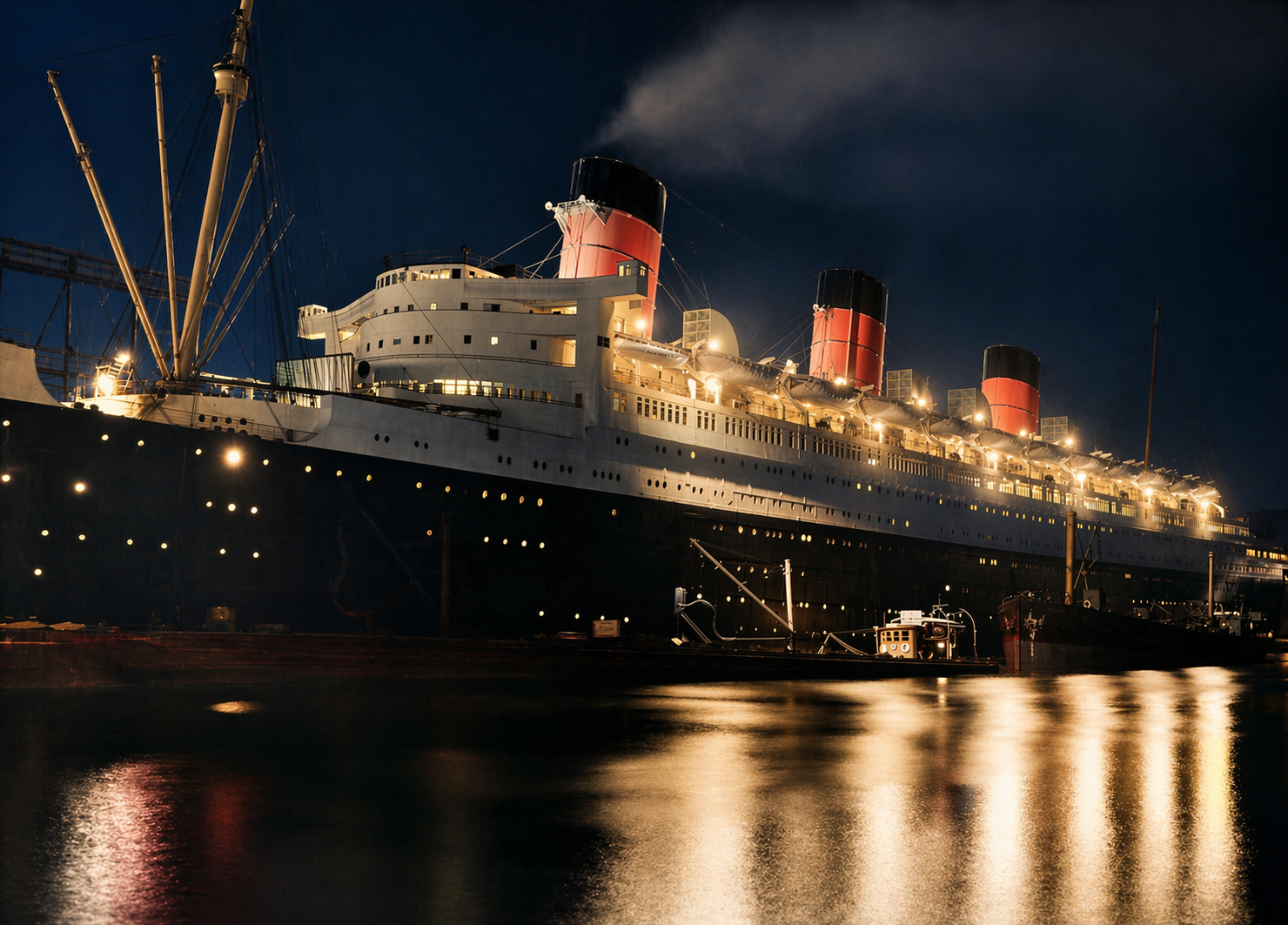
RMS Queen Mary — Specifications, Scale, and Comparison
A factual grounding page for one of the defining great liners of the Atlantic age: her size, principal dimensions, passenger capacity, and how she compared with some of the other ships that framed her era.
The aim here is not just to list numbers, but to explain what those numbers did—and did not—mean in practical, commercial, and historical terms.
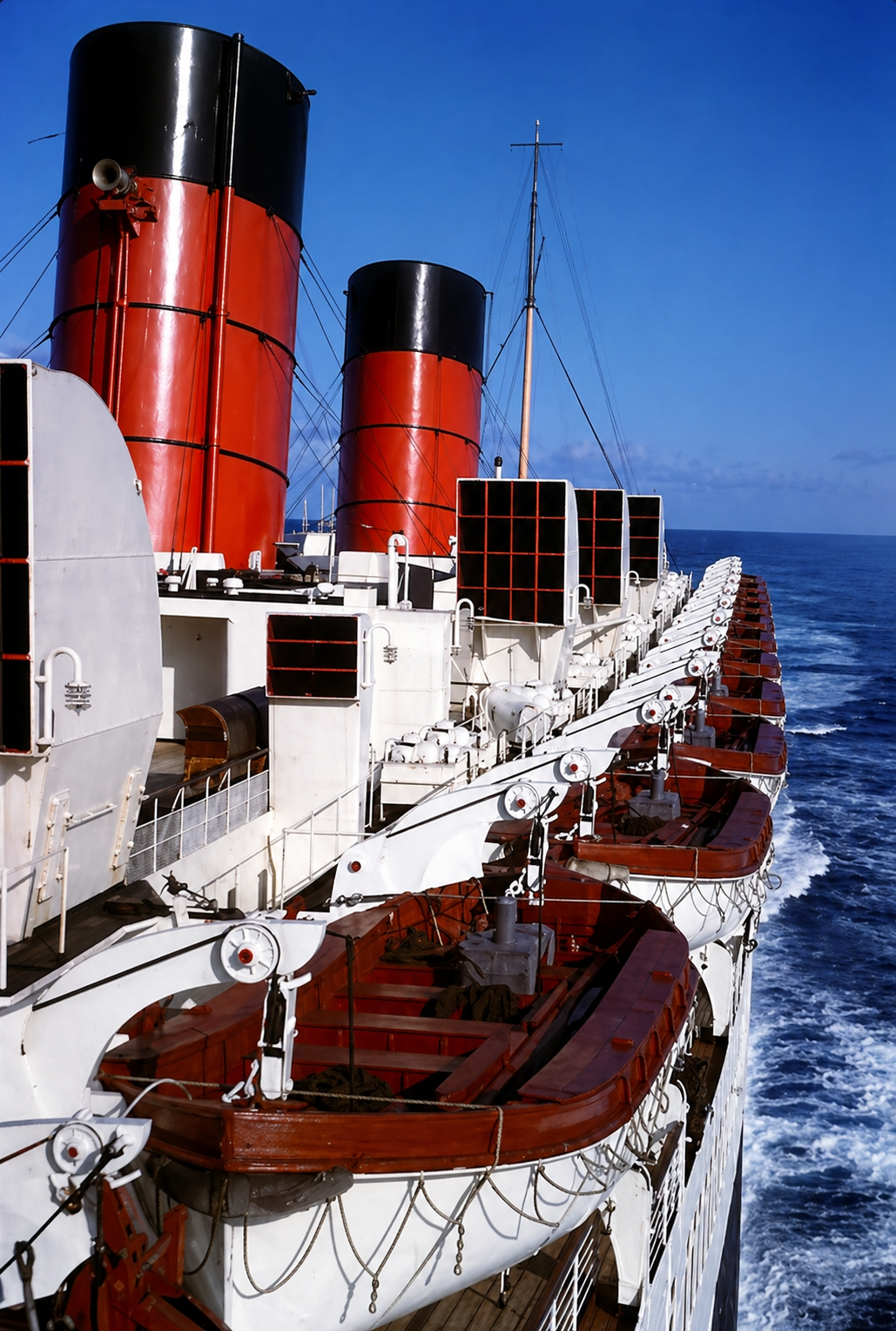
Scale needs context
Queen Mary was unquestionably one of the great giant liners, but tonnage, length, speed, and prestige do not all describe the same thing. This page treats those measures carefully rather than using them as interchangeable shorthand.
Principal specifications
These are the figures most readers look for first. Exact published numbers can vary slightly depending on date, measuring convention, wartime versus peacetime context, or whether a source is emphasizing design, service, or later historical memory.
Operator
Cunard-White Star Line
Builder
John Brown & Company, Clydebank
Gross tonnage
About 81,000 GRT
Length
About 1,019 feet
Beam
About 118 feet
Service speed
Roughly 28.5 knots
Passenger capacity
Roughly 2,100 passengers
Entered service
1936
Figures on famous liners are often repeated with more precision than the surrounding context deserves. For practical reading, approximate figures are usually more honest than false exactness—especially when layout, speed, and capacity changed across a ship’s life.
What those numbers actually mean
One of the easiest mistakes in ocean liner history is to treat every impressive number as though it describes the same quality. It does not. Gross tonnage is not a simple synonym for physical length, and neither tonnage nor length automatically tells us everything about atmosphere, prestige, or commercial success.
In Queen Mary’s case, the figures do confirm something important: she was genuinely one of the great large and fast liners of the twentieth century. That part is not myth. But those figures alone do not settle every question about style, public affection, or whether she should be read primarily as a technical triumph, a social world, or a national symbol.
This is one reason Queen Mary benefits from a layered reading. She can be understood first as a physically immense and technically formidable liner, and then as a ship whose cultural meaning was shaped by speed, wartime service, British identity, public interiors, and later preservation.
How Queen Mary compared
Comparison is where raw specifications become more useful. The table below is not meant to flatten these ships into a single ranking, but to give a sense of how Queen Mary sat within the larger field of famous North Atlantic liners.
| Ship | Approx. gross tonnage | Approx. length | Approx. service speed | General context |
|---|---|---|---|---|
| RMS Queen Mary | ~81,000 GRT | ~1,019 ft | ~28.5 knots | A giant express liner whose scale, speed, and later fame made her one of the defining ships of the Atlantic age. |
| SS Normandie | ~79,000 GRT | ~1,029 ft | ~29–30 knots | Queen Mary’s great French rival, often treated as her closest counterpart in interwar prestige and design ambition. |
| RMS Queen Elizabeth | ~83,000 GRT | ~1,031 ft | ~28.5 knots | A closely related but slightly larger successor, useful for showing how Queen Mary belonged to a broader Cunard conception of Atlantic leadership. |
| RMS Majestic | ~56,500 GRT | ~956 ft | ~23 knots | An earlier giant liner, impressive in scale but from a different generation of Atlantic competition. |
| RMS Olympic | ~45,000 GRT | ~882 ft | ~21–22 knots | Smaller and slower than Queen Mary, but historically important as a benchmark for an earlier expression of liner grandeur and steadiness. |
Comparison tables are useful, but they should not be mistaken for verdicts. A ship could be faster without being more beloved, larger without being more elegant, and more famous without being easier to interpret historically.
Scale in historical context
Immense by any fair standard
Queen Mary really was a giant ship by the standards of her own time. Discussions of her size are not just retrospective exaggeration; they reflect something contemporaries would have recognized immediately.
Speed mattered as much as size
Unlike some earlier giant liners, Queen Mary’s reputation cannot be reduced to dimensions alone. Her status was tied to express service, competitive Atlantic crossings, and the prestige that came with speed.
A ship between glamour and war
Queen Mary’s historical meaning was shaped not just by peacetime luxury but by wartime troopship service and long postwar memory. Her specifications anchor that story, but they do not exhaust it.
A liner of a later Atlantic era
One of the most important things about Queen Mary’s specifications is that they place her clearly in a later generation than ships like Titanic, Olympic, or Leviathan. She did not simply continue the Edwardian giant-liner formula. She belonged to an era that expected greater speed, a more modern silhouette, and a different relationship between national prestige and commercial competition.
That matters because readers sometimes compare all famous liners as though they were designed under one shared set of assumptions. They were not. Queen Mary was a product of the interwar contest for Atlantic supremacy, and her figures make the point: she was longer, heavier, and faster than many of the ships that dominate popular memory.
This is one reason Queen Mary is so useful as a reference anchor. Her specifications help mark the transition from the great prewar liners to the later, more streamlined and highly competitive generation that followed.
What the evidence supports — and what it does not
Basic figures for a ship like Queen Mary are generally better documented than many of the claims people build on top of them. It is usually much easier to establish approximate tonnage, length, and speed than to settle broader judgments about whether she was the most beautiful, the finest, or the single greatest liner ever built.
That distinction is worth holding onto. The record supports calling Queen Mary one of the largest, fastest, and most physically imposing liners of her era. It does not require us to collapse every measure of greatness into a single slogan. In other words, the numbers are real; the larger conclusions still need interpretation.
For Ocean Liner Curator, that is the right balance: take measurable scale seriously, then keep a little discipline when moving from measurement to mythology.
Claims about “largest,” “greatest,” or “best” often hide multiple criteria inside one word. This page is meant to keep those criteria visible rather than collapsing them into a single label.
Go deeper into Queen Mary
This page works best as a reference anchor. The fuller picture comes from pairing it with the interpretive, visual, and collecting pages that surround it.
Next steps within the Queen Mary cluster