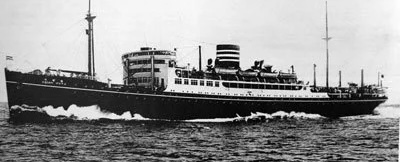
Heian Maru (1930)
Nippon Yusen Kaisha (NYK Line) · completed 1930 · Ship Guide
Overview
Heian Maru was a Japanese combined passenger-and-cargo motor liner of Nippon Yusen Kaisha, built for the Japan–Seattle trade. Completed in November 1930, she joined Hikawa Maru and Hie Maru in a three-vessel group that connected Japanese ports to Vancouver and Seattle.
Her peacetime career ended in 1941 with requisition by the Imperial Japanese Navy. Converted into an auxiliary submarine tender, she served in the western Pacific before being sunk at Truk lagoon during the American carrier attacks of February 1944. Her wreck remains an unusually tangible link between civilian passenger shipping and the Pacific War.
Key Facts
Construction and the Seattle Service
Ōsaka Iron Works laid down Heian Maru in June 1929 and launched her on 16 April 1930. She was completed on 24 November that year; her first recorded long-distance voyage began in Hong Kong on 18 December, bound for Seattle.
The line's regular route included Kobe, Nagoya, Shimizu, Yokohama and Vancouver as well as Seattle. The vessels carried passengers and freight together, an operating model suited to the long Pacific trade. Diesel propulsion helped define NYK's interwar modernization.
Three Related Liners
The surviving Hikawa Maru offers a valuable point of comparison for Heian Maru's peacetime appearance and interiors. Their third sister, Hie Maru, was originally styled Hiye Maru in English-language records.
The class designation should not be mistaken for evidence that all three vessels had identical operational experiences. Their wartime assignments and ultimate fates were quite different.
The Last Seattle Voyage and Naval Requisition
A detailed wartime movement record places Heian Maru's final return from Seattle at Yokohama on 16 August 1941, shortly before regular Japanese-flag sailings on that route ceased.
On 3 October 1941 she was requisitioned by the Imperial Japanese Navy, and during October conversion began at Kobe for submarine support duties. Naval alterations, equipment and camouflage transformed the meaning of photographs and descriptions from this later period.
Auxiliary Submarine Tender
In naval service Heian Maru was employed in supplying and supporting submarines and transporting stores across Japanese-controlled waters. Her movements included Kwajalein, Rabaul and Truk.
These activities were not continuations of ordinary passenger transport. Ship lists and memorabilia from the two periods should be identified by role and date rather than attributing military service indiscriminately to the NYK commercial route.
Sinking at Truk
During Operation Hailstone, the U.S. carrier strikes against the Japanese base at Truk on 17–18 February 1944, Heian Maru was attacked by American aircraft and sank in the lagoon.
Sources differ in assigning an exact calendar day to the final sinking: the Naval History and Heritage Command caption records 17 February, while several published movement summaries give 18 February. Both dates fall within the two-day operation, and the discrepancy should remain visible rather than be suppressed.
Interpretive Notes
Do not confuse sisters: the extant Hikawa Maru is a useful reference object but is not the surviving Heian Maru.
Route versus naval role: the Japan–Seattle liner period and submarine-tender phase are separate contexts for photographic identification and passenger documentation.
Loss date: evidence supports the February 17–18 attack window; an exact sinking date should be source-qualified.
The wreck as evidence: later photographs of the submerged hull document the ship's condition after decades underwater and should not be read as evidence of her original appearance or interior condition.
Evidence-first ship guideRelated Guides
Hikawa Maru offers a preserved sister for comparison. See also Asama Maru and Chichibu Maru for NYK's broader transpacific fleet.