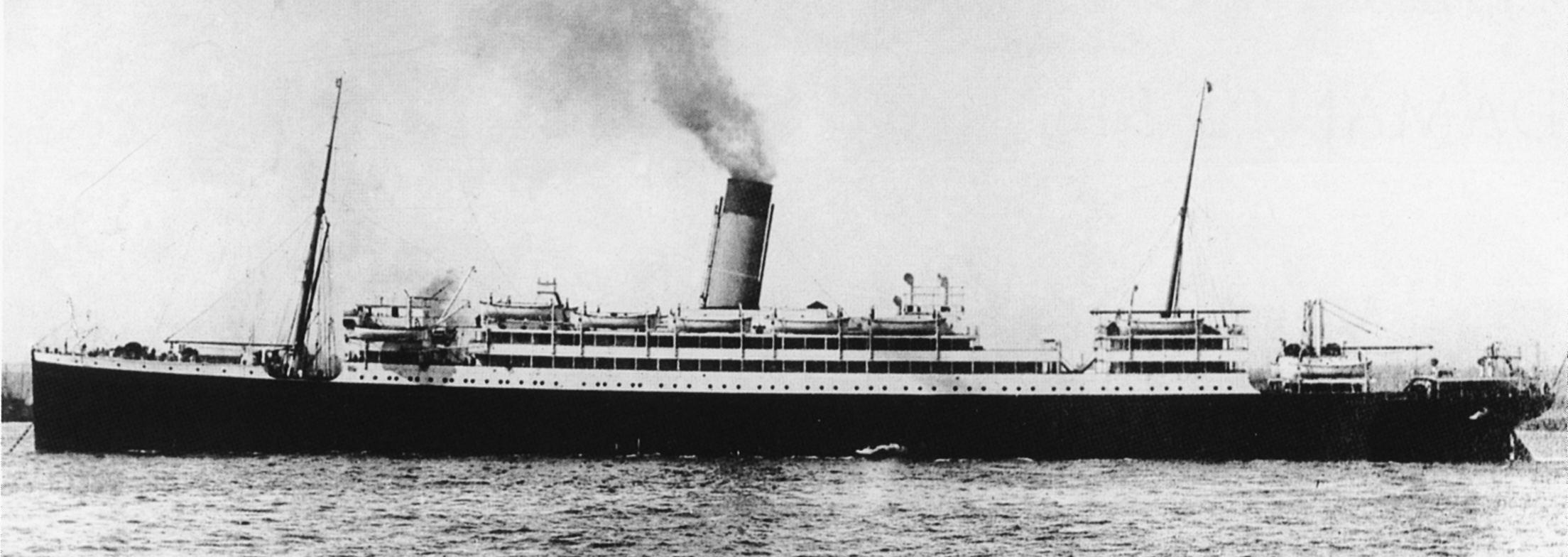
RMS Laurentic
White Star Line · launched 1908 · entered service 1909 · Ship Guide
Overview
RMS Laurentic was a White Star Line passenger liner built by Harland & Wolff for the Canadian trade. Originally conceived within the Dominion Line program as Alberta, she was transferred to White Star before completion, launched on 10 September 1908, delivered on 15 April 1909, and began her maiden voyage from Liverpool for Quebec and Montreal on 29 April.
Her historical importance reaches far beyond the gold bullion aboard her when she sank. Laurentic and near-identical sister Megantic formed a full-scale propulsion experiment. Megantic used conventional twin-screw reciprocating machinery; Laurentic combined two four-cylinder triple-expansion engines with a low-pressure exhaust turbine driving a third, center screw. The comparison helped validate the combination system later used in White Star's Olympic-class liners.
During the First World War Laurentic became an armed merchant cruiser. On 25 January 1917, after leaving Lough Swilly in severe winter weather, she struck mines laid by German submarine U-80 and sank with heavy loss of life. Her secret cargo of gold bullion then generated one of the most sustained salvage operations associated with an ocean-liner wreck.
This is the first White Star Laurentic, launched in 1908. A second ship of the name entered service in 1927 and must be treated separately in artifact attribution.
Key Facts
The Laurentic–Megantic Propulsion Experiment
The two sisters offered Harland & Wolff and the International Mercantile Marine organization an unusually controlled comparison because their hulls were effectively alike while their machinery differed. Laurentic's reciprocating engines exhausted steam into a low-pressure turbine, recovering energy that conventional machinery would otherwise waste.
Published engineering summaries report that Laurentic could produce roughly 20 percent more power than Megantic for similar coal consumption, or use about 12–15 percent less coal for comparable power. The figures vary by how the trials are summarized, but the conclusion was clear enough to influence the propulsion arrangement selected for Olympic, Titanic, and Britannic.
This makes Laurentic an important technical predecessor to the Olympic class rather than simply a Canadian-service liner later made famous by a wreck.
Canadian Service
From 1909 to the outbreak of war, Laurentic worked the Liverpool–St. Lawrence trade, carrying passengers and cargo to Quebec and Montreal. The route placed her within White Star's joint Canadian strategy rather than the Liverpool–New York express competition that dominates popular histories of the company.
Her large third-class capacity reflects the migration component of that service, while first- and second-class accommodation supported business, tourism, and family travel across the North Atlantic.
War Service and Sinking
The Admiralty requisitioned Laurentic in 1914 and commissioned her as an armed merchant cruiser. On her final voyage in January 1917 she was outward bound for North America carrying a high-value government shipment of gold bullion.
After a stop at Buncrana in Lough Swilly, she departed on the evening of 25 January in blizzard conditions. Shortly before 6 p.m. she struck two mines from a field laid by German submarine U-80. One explosion disabled electrical power and pumps, worsening evacuation in darkness and severe cold. The ship sank rapidly, and many who escaped the hull died from exposure.
The Bank of England archive records approximately 350 deaths. Other commemorative sources give totals a few lives higher, so this guide avoids pretending the surviving tallies are perfectly uniform.
The Gold Salvage
The bullion cargo—commonly described as 3,211 gold bars worth about £5 million in 1917—made the wreck strategically important almost immediately. Official divers recovered hundreds of bars during the war and returned repeatedly afterward under difficult conditions.
Bank of England records document 492 bars recovered in 1917 and another 315 in 1919, with further recoveries in subsequent years. By the 1920s almost all of the shipment had been salvaged; later accounts commonly state that a small number of bars remained unrecovered.
The archival record matters because the “gold ship” story can easily drift into treasure mythology. The salvage was principally a government financial-recovery operation conducted over years, not a single dramatic treasure hunt.
Interpretive Notes
The gold should not erase the ship: Laurentic's propulsion experiment and Canadian passenger service are historically significant in their own right.
Engineering context links sister ships: understanding Laurentic requires comparison with Megantic; neither machinery story is complete alone.
Two Laurentics: date, machinery, silhouette, route, and company typography should be used to distinguish the 1908-launched ship from the 1927 vessel.
Evidence-first ship guideSources (Selected)
- Ocean Liner Curator — Sources (master bibliography)
- Harland & Wolff — ship no. 394, Laurentic
- Bank of England Archive — HMS Laurentic salvage operations, 1917–23
- Bank of England Archive — HMS Laurentic salvage operations, 1924–52
- Wikipedia — SS Laurentic (1908), with cited engineering and naval references