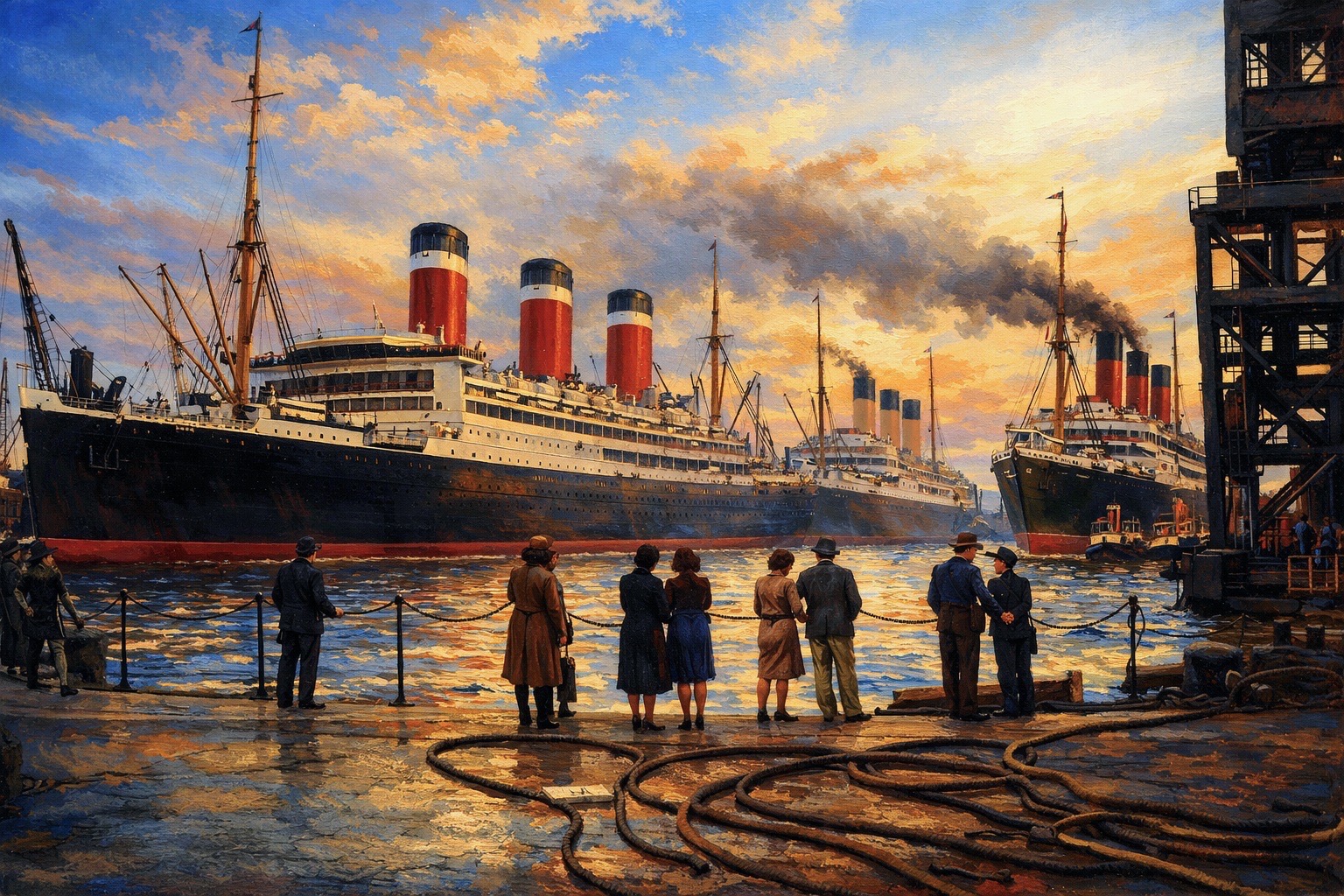
British and German Ocean Liners Before 1914
Before the First World War, British and German companies competed across the North Atlantic in speed, scale, migration traffic, engineering, publicity, and national prestige.
Basic answer
What made the British-German rivalry important?
Britain entered the steam-liner age with strong shipping traditions, shipyards, imperial routes, and established companies. By the late nineteenth century, German firms such as Norddeutscher Lloyd and Hamburg-Amerika Linie challenged British dominance with fast express liners, huge emigrant operations, and increasingly ambitious prestige ships.
The competition was commercial, technological, and symbolic. Deutsches Museum describes turn-of-the-century passenger ships as expressions of industrial-national prestige, with vessels such as Kaiser Wilhelm II and later Europa embodying that relationship between performance and national image.
Contrasts
Different positions in the same market
British incumbency
British firms already possessed mature Atlantic services, major shipyards, mail traditions, and global networks.
German challenge
German lines used new ships, coordinated migrant traffic, and conspicuous technical achievement to build international status quickly.
Migration
Both national systems profited from mass passenger movement; luxury publicity should not obscure the importance of steerage traffic.
Prestige
Speed records and giant ships became public evidence of industrial capacity at a moment of intense national competition.
Case studies
Ships that show the rivalry changing
Selected sources
Where this comparison comes from
Continue the series