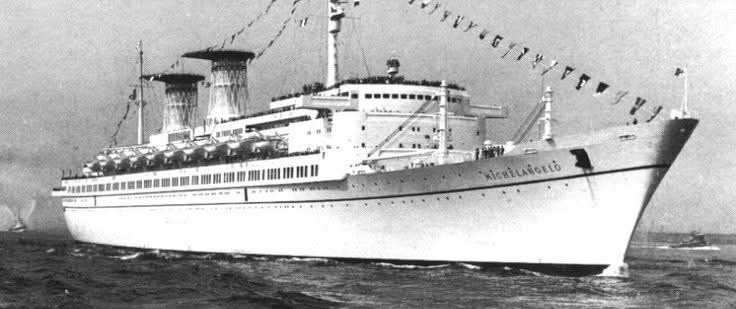
Michelangelo & Raffaello: Italy’s Last Atlantic Sisters
Completed in 1965, Michelangelo and Raffaello were true sister ships built from one coordinated design in two different Italian yards. Their shared hull and machinery concealed deliberately different interior identities—and their short careers reveal how quickly the jet age overtook even the most modern liner.
Basic answer
Were Michelangelo and Raffaello true sister ships?
Yes. Unlike Rex and Conte di Savoia, which were parallel Italian prestige ships rather than conventional sisters, Michelangelo and Raffaello were conceived as a matched pair. They shared the same basic hull form, principal dimensions, machinery concept, and distinctive lattice-sided funnels.
One platform, two yards
A coordinated design built far apart
Michelangelo was built by Ansaldo at Sestri Ponente near Genoa, while Raffaello was built at the San Marco yard at Trieste. The Italian Liners Historical Society describes the pair as an unusual early example of two large identical passenger ships being constructed simultaneously in different yards using coordinated technical information.
That arrangement mattered beyond these two ships. It anticipated the later industrial logic of building related ships across multiple yards from a common design platform rather than relying on one yard for an entire class.
Shared naval architecture
The same outward language
Michelangelo
About 276 metres long, twin-screw, steam-turbine powered, and designed for roughly 26.5-knot service on the Italy–New York route.
Raffaello
Nearly identical in principal dimensions and machinery concept, built to work as the second half of the same flagship program rather than as a separate experiment.
Funnels
The paired lattice-sided funnels became the sisters’ most recognizable visual signature and were intended to manage exhaust while preserving a highly distinctive modern profile.
Passenger structure
Both were conceived for three-class Atlantic service, a layout that made sense for liner operation but later limited easy conversion to the emerging mass-market cruise model.
Interior identity
Sisters outside, different worlds inside
The strongest design distinction between the ships lay inside. Although the sisters shared their basic technical platform, their interior furnishing was deliberately differentiated. Contemporary design policy treated the ships as showcases for postwar Italian architecture, furniture, decorative art, and industrial design rather than as mirror-image interiors.
This makes interior attribution especially important. A photograph that is merely “Italian Line, 1965” is not enough to identify a room to one sister. Room name, designer, deck location, contemporary caption, or ship-specific printed evidence should take precedence over resemblance alone.
A late decision
Modern liners for a disappearing market
Planning began while the North Atlantic still retained symbolic and commercial importance, but construction stretched into the period when jet aircraft were rapidly taking over long-distance passenger travel. By the time both ships entered service in 1965, the strategic problem had changed.
The result was not that the sisters were technically obsolete. They were modern ships optimized for a transportation system that was becoming commercially obsolete. That distinction is essential: their short careers say more about market transformation than about design failure.
Speed and correction
Even sister ships could diverge during trials
Italian Liners Historical Society material records that Michelangelo initially failed to reach the intended speed during trials. Analysis of the hull and propeller flow informed modifications applied before Raffaello completed her own trials, allowing the second sister to benefit directly from the first ship’s experience.
This is precisely the sort of evidence that makes sister-ship comparison useful. A shared design does not freeze two ships into one technical biography; construction sequence, trials, correction, maintenance, and later service can still produce meaningful divergence.
Atlantic reality
Ten years at the end of an era
Michelangelo reached New York in May 1965 and Raffaello followed that summer. Their decade of Italian Line operation combined scheduled crossings with increasing cruise work as the Atlantic passenger market weakened.
Both ships were expensive to operate and difficult to adapt fully to a cruise market that increasingly favored different cabin arrangements, more flexible public spaces, and different economics. They were withdrawn in 1975, only ten years after entering service.
Different service memories
Michelangelo and the 1966 storm
The sisters shared a program, but Michelangelo acquired a ship-specific place in maritime memory after the severe North Atlantic storm of 12 April 1966. An exceptional wave struck the forward superstructure, causing three deaths, more than fifty injuries, and heavy damage documented in surviving photographs.
That event should not be allowed to define Raffaello by association. It is a useful example of why one sister’s dramatic episode can distort later memory of the pair if ship-specific evidence is not kept separate.
After the Italian Line
Parallel sale, divergent endings
After withdrawal, both sisters were sold to Iran for static accommodation. Their shared passenger careers had ended, but their physical afterlives diverged. Raffaello was hit during the Iran–Iraq War in 1983 and remains a wreck near Bushehr. Michelangelo survived longer in static use before being sold for demolition and scrapped at Gadani in 1991.
The contrast is useful because it shows how quickly two nearly identical liners can become very different historical objects once their common operating system disappears.
Timeline
One program, two careers
Both sisters are laid down
The coordinated flagship program takes physical form at separate yards in Genoa and Trieste.
Michelangelo and Raffaello are launched
The ships emerge publicly as a matched pair despite being constructed on opposite sides of northern Italy.
Both enter service
The sisters join the Italy–New York trade at the same moment jet travel is transforming transatlantic passenger economics.
Michelangelo’s storm casualty
A severe wave strike creates the most dramatic event in the active career of either sister.
Italian Line service ends
Both ships are withdrawn after only a decade, closing the final chapter of Italy’s purpose-built Atlantic superliner program.
Iran and divergent afterlives
Static accommodation gives way to wreck status for Raffaello and eventual scrapping for Michelangelo.
Read the sisters together
Two guides, one design program
Related interpretation
Continue the Italian liner story
Evidence note
Do not flatten sister ships into one biography
Michelangelo and Raffaello are unusually useful for comparison precisely because they were so closely related. Shared dimensions, machinery, profile, and corporate branding can tempt later sources to treat them as interchangeable. Strong attribution keeps ship-specific interiors, trial changes, accidents, voyage material, and afterlives separate while recognizing the shared platform that made the pair possible.
Selected sources