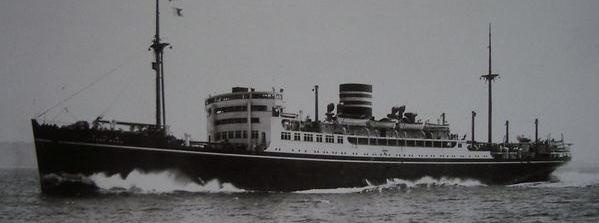
NYK Hikawa Maru
NYK Line (Nippon Yusen Kaisha) · 1930 · Ship Guide
Overview
Hikawa Maru is one of the most accessible surviving “liner-era” passenger ships of the Pacific: a Japanese-built cargo-passenger liner completed in 1930 for NYK’s North America service linking Japan with Vancouver and Seattle. Her story combines prewar ocean travel, wartime conversion, postwar repatriation and commercial return, and—unusually—continuous physical survival into the present as a preserved ship at Yokohama’s Yamashita Park.
For collectors, Hikawa Maru sits in a sweet spot where the paper trail can be richly “named”: NYK house style often printed ship name, route, and corporate identity clearly on brochures, luggage labels, sailing notices, and passenger documents. The key is to anchor attributions to what the object itself says (ship name + date/route), rather than to later narrative labels such as “prewar Japan–America liner” or “WWII hospital ship.”
Evidence-first note: The ship is sometimes branded “NYK Hikawamaru” in preservation-era materials. Treat that as a museum identity rather than a separate vessel; catalog by era (prewar liner, wartime hospital ship, postwar repatriation/return) using printed dates and context on the artifact.
Key Facts
Design & Construction (Context)
Built at the end of the 1920s, Hikawa Maru represents a modernized “motor ship” approach applied to long-distance passenger service: a cargo-passenger liner designed to carry people, mail, and freight efficiently across the Pacific rather than to chase headline speed records. In practice, that means her documentary trail often reads as route + service (schedules, port calls, baggage, ticketing) more than “floating palace” celebrity.
The ship also sits in a historically important travel corridor: for much of the prewar period, the Japan–North America service was a primary link between Japan and the Pacific Northwest. When you encounter NYK printed material with “Seattle Line,” “Vancouver,” or “Yokohama,” treat those specifics as high-value anchors for dating and attribution.
Service History (Summary)
1930–1941: Pacific cargo-passenger service. Completed on 25 April 1930 and placed on the Japan–Seattle route, Hikawa Maru operated as a cargo-passenger liner across the Pacific in the years before the Pacific War interrupted commercial sailings. NYK’s own historical summary emphasizes this as her most “liner-like” era, producing many of the classic collectibles: passenger lists, brochures, menus, stationery, and voyage-advertising ephemera.
1941–1945: Wartime hospital ship. In late 1941 the ship was converted for naval hospital service. Operational narratives and compiled movement tables describe repeated deployments transporting wounded and supporting Japanese operations, and note that she survived mine damage on multiple occasions—useful context, but for collecting purposes, always prefer dated documents (letters, photos, official markings) over generalized “hospital ship relic” claims.
1945–1953: Repatriation and return to managed operations. After Japan’s surrender, Hikawa Maru entered the postwar transport world—movement of people, repatriation, and managed service. Materials from this era often look more administrative than glamorous: transport paperwork, notices, and utilitarian shipboard printing.
1953–1960: Commercial return and retirement. Hikawa Maru is widely described as refitted and returned to NYK’s Seattle service in the 1950s before her final withdrawal from service in 1960. Items from this phase can be mis-sold as “prewar”—so watch paper stock, typography, and, best of all, printed dates.
1961–present: Preservation at Yokohama. Permanently berthed from 1961, the ship became a floating museum (with periods of closure/restoration). Preservation-era items (admission tickets, museum brochures, restoration literature) are collectible in their own right—just catalog them as museum-era rather than as “original liner service” artifacts.
Japan–Seattle Service in Concrete Terms
NYK's official history records that Hikawa Maru spent eleven years and three months on the Japan–Seattle line before the route was suspended in 1941. During that prewar period she completed 73 Pacific voyages and carried roughly 10,000 passengers.
Those figures help place the ship in context: she was not merely a preserved showpiece that happened to have crossed the Pacific, but a working cargo-passenger liner embedded in a regular commercial route linking Japan with Vancouver and Seattle.
Hospital Ship, Repatriation Ship, and Merchant Ship
In late 1941 Hikawa Maru was requisitioned and converted into an auxiliary hospital ship, with hospital spaces installed while several first- and second-class public rooms were retained. NYK records that she completed 24 hospital-ship voyages and transported more than 30,000 wounded and sick personnel.
After the war, the same hull was used for demobilization and repatriation work before returning to merchant service. That sequence creates unusually clear documentary phases: prewar liner, wartime hospital ship, postwar repatriation vessel, restored cargo-passenger liner, and finally museum ship.
A Preserved Ship with National Cultural Status
Hikawa Maru has remained at Yokohama's Yamashita Park since 1961 and reopened after major restoration in 2008. In 2016 she was designated an Important Cultural Property of Japan, recognized both for her role in twentieth-century transport history and for surviving shipbuilding and interior-design fabric.
That survival gives the ship a rare evidentiary advantage: researchers can compare documentary sources with an extant hull and surviving interiors rather than relying solely on plans, photographs, and fragments.
Interpretive Notes
Hikawa Maru is often marketed with a mix of romance (“prewar Pacific liner”) and drama (“wartime hospital ship”). That combination creates predictable attribution traps. Three practical checks help keep listings honest:
1) Printed route & ports: “Seattle,” “Vancouver,” and “Yokohama/Kobe” references are strong anchors for prewar/postwar liner material.
2) Era cues: Museum-era printing is usually explicit (NYK Hikawamaru branding, admission language, modern disclaimers). Don’t let it “drift” into 1930s claims.
3) Hospital-ship claims: Ask what the object itself documents (date, unit, medical marking, censor stamp, official header). Narrative alone is not evidence.
A special note on “celebrity passenger” associations (often repeated in popular accounts): treat them as secondary unless your object is directly dated and tied to the voyage by printed sailing information, passenger list context, or an unbroken provenance chain.
Evidence-first ship guideSources (Selected)
This list is purposely conservative.
- Ocean Liner Curator — Sources (master bibliography)
- NYK Hikawa Maru (official) — History (English)
- 日本郵船氷川丸(公式)— 氷川丸の歴史(Japanese)
- CombinedFleet — IJN Hospital Ship Hikawa Maru (movement record; useful for wartime chronology checks)
- Wikipedia — Hikawa Maru (starting index; verify against registers/NYK materials)
- Japan National Tourism Organization — NYK Hikawa Maru (public-facing overview)
- NYK Line — 2025 long-term preservation project for Hikawa Maru